How did a bank full of “safe” assets go bust?
SVB’s collapse exposed a crucial difference: getting your money back eventually is not the same as having it when you need it.
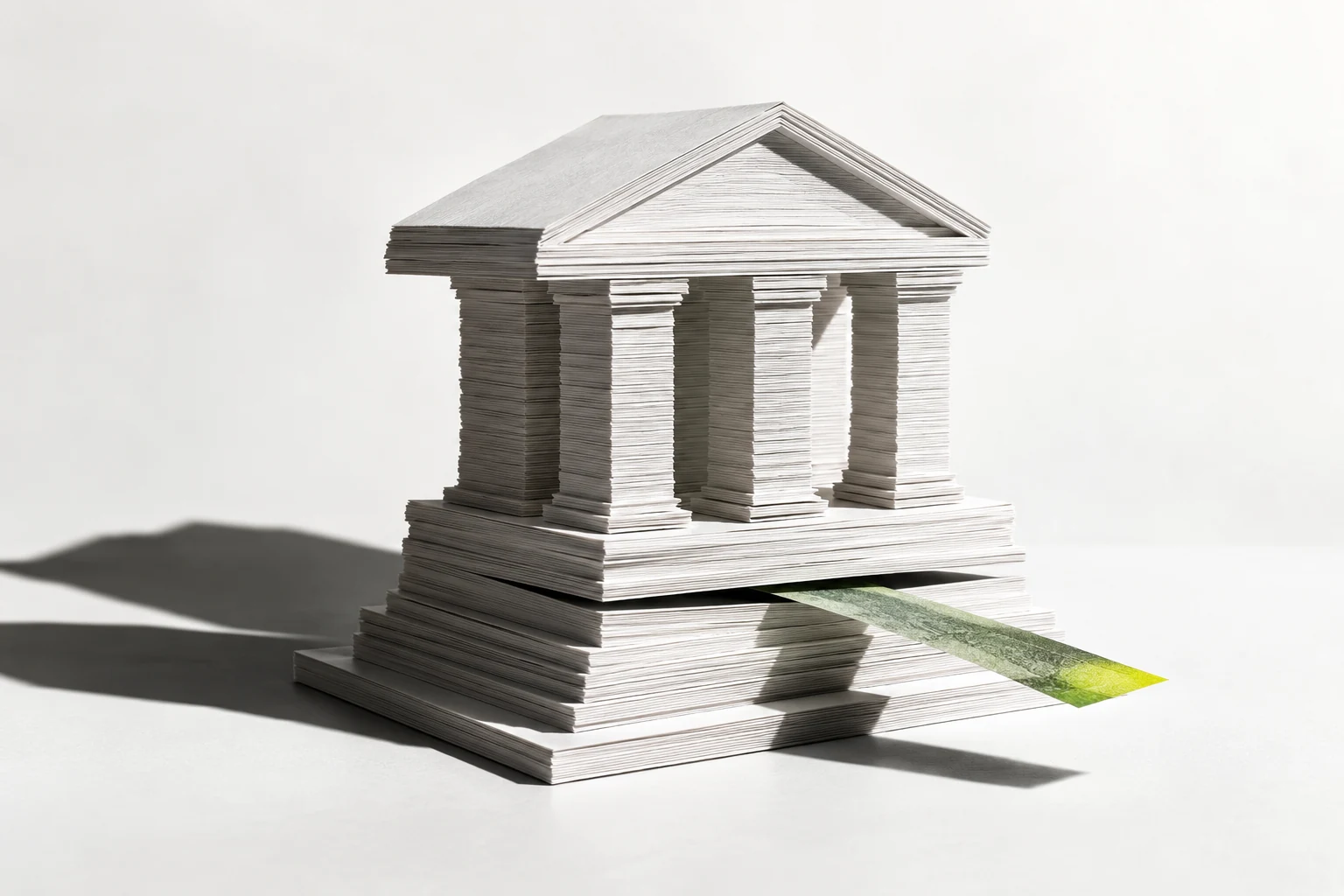
In this story
A depositor wants money today. A bond promises money years from now. A bank has to make those two clocks work together.
Silicon Valley Bank’s deposit base expanded rapidly during the technology boom. Much of that funding went into longer-term securities. As rates rose and technology-sector activity slowed, the bank faced both falling securities values and deposit withdrawals. It closed on 10 March 2023. [1]
Two different clocks.
Consider an imaginary bank. It accepts a $100 deposit and invests $90 in a bond, keeping $10 in cash. The balance sheet still contains $100 of assets. But only $10 is immediately available without selling or borrowing against something.
If the depositor asks for $5, the bank can use its cash. If the depositor asks for $100, the bond’s resale price and the bank’s ability to borrow suddenly matter a great deal. A promise of repayment in the future cannot, by itself, settle a withdrawal today.
The price of waiting.
A fixed payment becomes less attractive when comparable new investments offer a higher return. An existing fixed-rate bond therefore generally falls in price as its market yield rises—even if the issuer’s ability to repay is unchanged. [2]
Price today for $100
received in 10 years
The same payment,
discounted at a higher rate
The promised payment in this example has not changed. The price someone will pay for it has. More distant payments are generally more sensitive to a change in the discount rate, all else equal. [2]
When waiting stops being an option.
SVB’s problem became acute when customers wanted their deposits back. On 8 March 2023, the bank announced a securities sale and a plan to raise capital. More than $40 billion in deposits left the next day. The Federal Reserve’s review describes a concentrated, largely uninsured deposit base, deficient risk management and failures of supervision—not simply an unfortunate bond trade. [1]
For our imaginary bank, selling an asset below its purchase price might provide cash while also crystallizing a loss. That is why the timing of liabilities has to be considered alongside the value and liquidity of assets.
“Will I be repaid?” and “Can I pay you now?” are different questions.
What “safe” leaves out.
Credit risk concerns repayment. Interest-rate risk concerns changes in value as rates move. Liquidity concerns the ability to meet a cash need. An asset can look strong on the first dimension and still create problems on the other two.
That distinction is the useful lesson to carry into another balance sheet: whose money is due, when is it due, and what must happen to make the cash available?
Two bonds. One change in yield.
An illustrative question, not an assessment of exam readiness. Your answer stays on this page and is not saved.
Sources & notes
- Federal Reserve · Review of the supervision and regulation of SVB, executive summary, April 2023
- SEC Investor.gov · Interest-rate risk and fixed-rate bond prices
Sources checked 7 September 2026. Numerical examples and learning questions are original illustrations by The Margin. Historical events are identified by their event dates.